

Why Canadians Are Switching to Standing Desks
Remote and hybrid work are here to stay, and more Canadians are realizing that a kitchen chair and a fixed desk are not a long-term plan. A standing desk lets you alternate between sitting and standing throughout the day, which helps your posture, your energy, and your back. But with so many models on the market, how do you choose the right one? This guide covers the five things that actually matter.
1. Height Range: It Has to Fit Your Body
The desk should go low enough for comfortable sitting and high enough for standing with your elbows at about 90 degrees. A range of roughly 73 to 118 cm works for most adults. If you are taller than average, check the maximum height carefully — a desk that stops too low forces you to hunch over, which defeats the purpose.
2. Load Capacity: Count Your Gear
Add up everything that will live on your desk: monitors, laptop, speakers, books. Most home setups weigh between 15 and 30 kg. A capacity of 60 kg gives you comfortable headroom for a dual-monitor setup. Going far beyond that is rarely necessary for a home office.
3. Motor and Memory Presets
Single-motor desks are the budget-friendly standard and are perfectly smooth for everyday use. Dual motors lift faster and carry more, at a higher price. What matters most day to day is the controller: memory presets let you return to your exact sitting and standing heights with one button, so switching position takes seconds instead of becoming a chore you skip.
4. Desktop Size: 120 x 60 cm Is the Sweet Spot
A 120 x 60 cm top fits two monitors and a laptop without feeling cramped, while still fitting in a bedroom corner or a small apartment. Go bigger only if you have the room — and measure your space before ordering.
5. Warranty, Returns, and Who You Are Buying From
Check the return window and what happens if something goes wrong in a year. Buying from a Canadian company means no surprise customs fees, faster delivery, and support you can actually reach. It also means your purchase supports a local business instead of a container-shipping giant.
What Should a Good Standing Desk Cost in Canada?
Expect to pay between 250 $ and 400 $ for a solid electric desk with memory presets. Below that range, corners are usually cut on the frame or the motor. Above it, you are paying for dual motors, bigger tops, or brand marketing. Accessories — a monitor arm, a good desk lamp — complete the setup and are often where comfort is really won.
Our Pick: The Ninja Desk
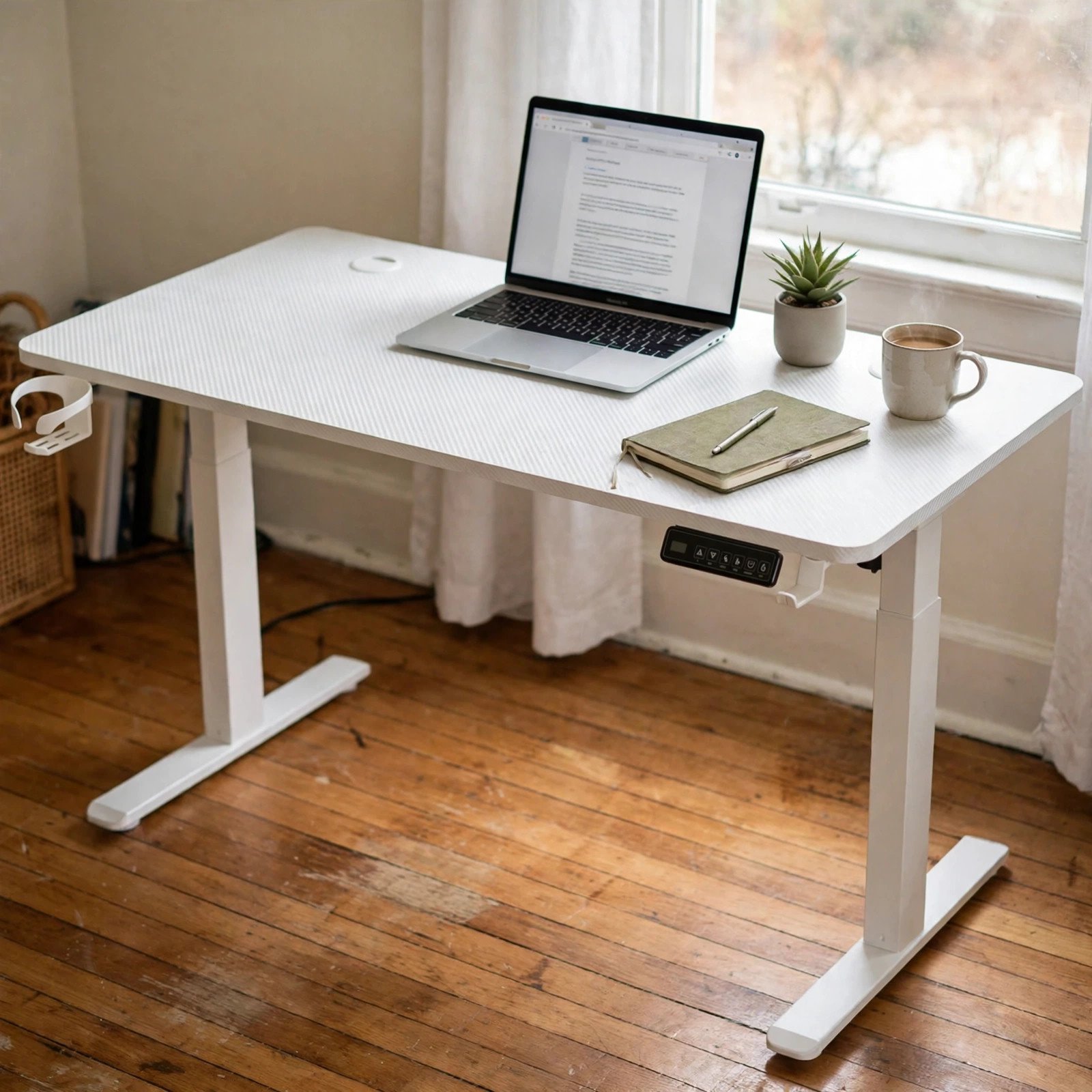
We designed the Ninja Desk in Quebec to hit that sweet spot: a 120 x 60 cm top, a 73 to 118 cm height range, 60 kg of capacity, memory presets, and assembly in about 15 minutes — for 259 $, with free delivery. Use the code WELCOME10 for 10% off your first order. It is the desk we sell because it is the desk we would buy at this budget.
Frequently Asked Questions
Is a single-motor standing desk reliable?
Yes. For a standard home-office load, a single motor with a synchronized frame is smooth, quiet enough for calls, and built to last. Dual motors matter mainly for very heavy or extra-wide setups.
How long should I stand each day?
Start with 20 to 30 minutes of standing per hour and adjust. The goal is not to stand all day — it is to change position regularly.
Can I add a monitor arm later?
Absolutely. A monitor arm frees up desk space and puts your screens at eye level. Browse our complete setup to pair the desk with an arm and a lamp.
Ready to move more while you work? See the Ninja Desk and build your setup today.
Ready to upgrade your workspace? Discover the Ninja Desk — our electric sit-stand desk designed in Quebec.

Ninja Desk
$259.00Select options This product has multiple variants. The options may be chosen on the product page
Use code WELCOME10 — 10% off your first order.